
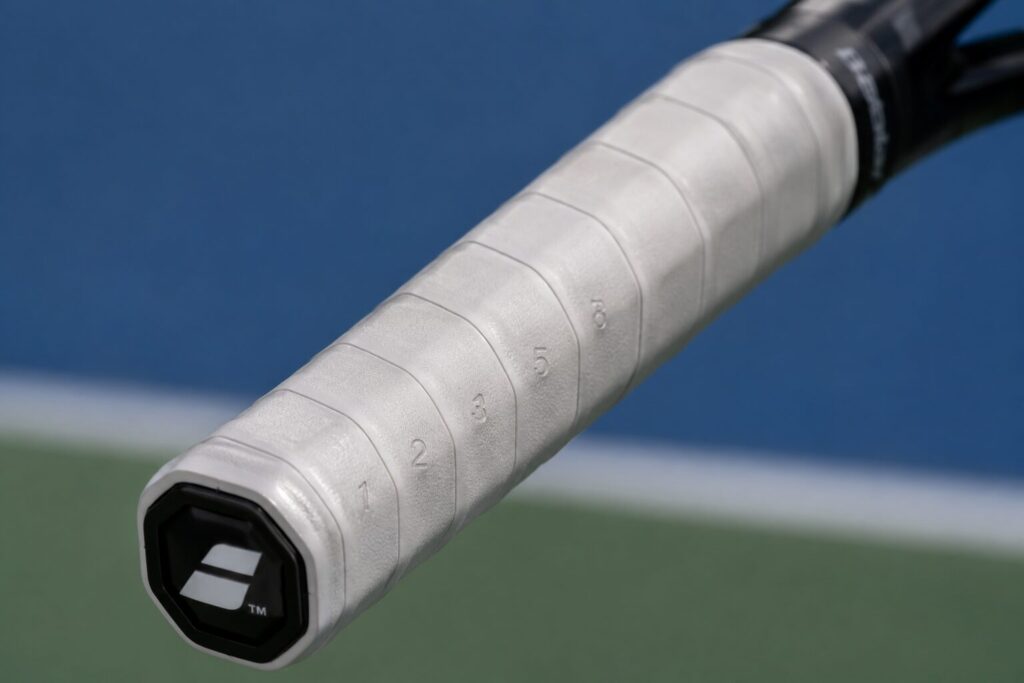
A tennis racket handle isn’t round — it’s shaped like an octagon, meaning it has eight flat sides, or bevels. These bevels are the key to understanding how grips work in tennis. When a coach tells you to use a “Continental grip” or “Semi-Western forehand,” what they really mean is: put the base knuckle of your index finger (and usually the heel pad of your hand) on a specific bevel.
Knowing how to identify and feel these bevels is essential for learning, practicing, or correcting your grip. However, when you use a tennis grip training tool, you don’t really need to worry much about bevels and their numbering because of the tactile feedback that these tools provide.
Still, it is helpful to understand bevels. So, let’s have a look at how they work.
How Bevel Numbering Works (for Right-Handed Players)
Right-handed
Bevels 1–8 clockwise
Starting at the top flat face, bevels are numbered 1–8 going clockwise around the handle when viewed from the butt cap.
Hold your racket out in front of you with the strings perpendicular to the ground, and the face of the racket vertical. Now look at the top edge of the handle — the bevel that’s pointing straight up. That is Bevel 1.
From there, number the bevels clockwise around the handle if you’re right-handed:
Bevel 1 – Top bevel (neutral)
Bevel 2 – Slightly right of top
Bevel 3 – Right side
Bevel 4 – Bottom right
Bevel 5 – Bottom
Bevel 6 – Bottom left
Bevel 7 – Left side
Bevel 8 – Upper left
This numbering provides a common language across coaching systems.
When someone says “your forehand grip is too Western,” they likely mean your knuckle is landing closer to bevel 5 than bevel 3 or 4.
How Grip Types Align with Bevels
Tennis grips are typically defined by where the base knuckle of the index finger and the heel pad sit on the handle.
For right-handers:
Continental Grip – Bevel 2
Bevel 2 — Continental Grip
Index knuckle and heel pad on bevel 2. Used for serves, volleys, slices, overheads, and the dominant hand in two-handed backhands.
Eastern Forehand Grip – Bevel 3
Bevel 3 — Eastern Forehand
Index knuckle and heel pad on bevel 3. A versatile all-court grip that produces flatter shots — classic and still widely used.
Classic but still useful all-court grip, flatter shots.
Semi-Western Forehand Grip – Bevel 4
Bevel 4 — Semi-Western Grip
Index knuckle and heel pad on bevel 4. For heavy topspin and modern baseline play, popular on the ATP Tour.
Great for topspin and modern baseline play, generates tons of spin.
Western Forehand Grip – Bevel 5
Bevel 5 — Western Forehand
Index knuckle and heel pad on bevel 5. Generates extreme topspin with a heavily closed racket face. Demanding to use; for advanced players.
Two-handed backhands involve both hands on different bevels — for example, dominant hand on bevel 2 (Continental), non-dominant hand on bevel 6 or 7 (mimicking a lefty forehand).
How Bevel Numbering Changes for Left-Handed Players
Left-handed
Bevels 1–8 counter-clockwise
For left-handed players, bevels run 1–8 counter-clockwise from the same top face, mirroring the right-handed layout.
For left-handed players, the physical shape of the handle doesn’t change, but the bevel numbers rotate in the opposite direction.
Left-handed players number the bevels counter-clockwise, starting from the same Bevel 1 at the top:
Bevel 1 – Top (same as righties)
Bevel 8 – Right of top
Bevel 7 – Right side
Bevel 6 – Bottom right
Bevel 5 – Bottom
Bevel 4 – Bottom left
Bevel 3 – Left side
Bevel 2 – Upper left
That means if you’re left-handed, the numbers are mirrored in reference to right-handed bevel numbers.
For example, when a right-hander puts their hand on bevel 3 for an Eastern forehand, a left-hander would be on bevel 7 (according to the right-handed bevel numbering system) to achieve the same angle.
This mirroring is why the Gripsnake is available in two different versions, one for right-handed, and one for left-handed players. The placement and angle of the training guides must account for this reverse bevel logic.
Bevel Grips in Practice — Why It Matters
You may be wondering: do bevels really matter that much?
Yes. Most grip-related issues — like mishits, off-center contact, lack of or spin inconsistency, shots that sail long or wide, or sore wrists — come down to gripping the wrong bevel for the stroke you’re attempting. Once you understand where each grip lives on the handle, you can quickly:
Diagnose and fix bad habits
Understand grip changes between strokes (e.g. serve vs groundstroke)
Switch grips faster in live play
Communicate more clearly with your coach or training partner
And if you’re a coach, bevel knowledge lets you speak a common language across all students — especially when helping left-handed players who often get overlooked in generic grip advice.
Recap: Key Takeaways
A tennis racket handle has 8 bevels, numbered clockwise for right-handers, counterclockwise for left-handers.
Bevel 1 is always the top bevel when the racket face is perpendicular to the ground.
Grips are defined by the position of the index finger’s base knuckle and heel pad on the handle’s bevels.
Right-handers: Continental = bevel 2; Eastern = bevel 3; Semi-Western = bevel 4; Western = bevel 5.
Left-handers: Continental = bevel 8; Eastern = bevel 7; Semi-Western = bevel 6; Western = bevel 5.